About LANDIS THREADING MACHINE
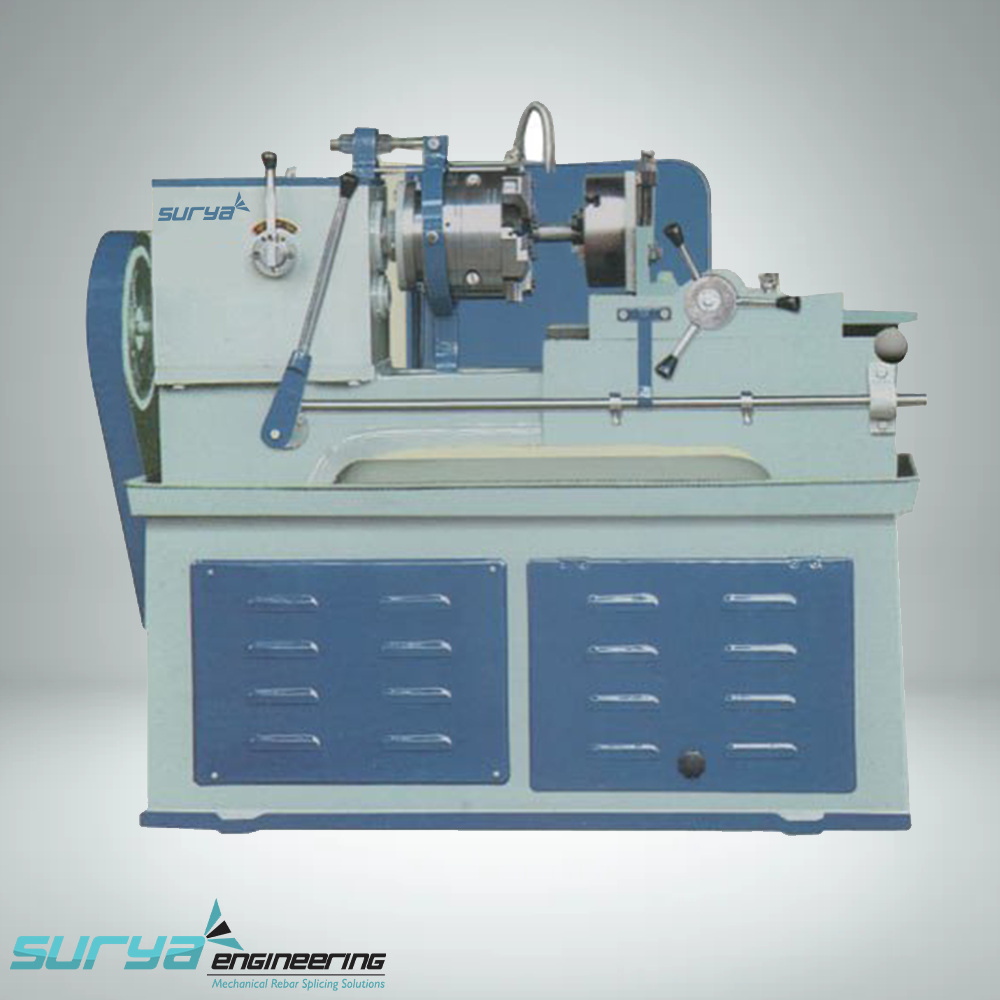
What is a LANDIS Threading Machine?
A LANDIS Threading Machine is a high-precision industrial machine used to create threads on:
- TMT bars
- Steel rods
- Pipes
- Bolts
- Fasteners
The machine uses special LANDIS threading dies/chasers to cut or roll accurate threads for mechanical coupler systems. These threads are later connected using rebar couplers for RCC construction.
LANDIS machines are highly popular in:
- High-rise construction
- Bridge projects
- Metro rail projects
- Industrial fabrication
- Infrastructure development.
Why LANDIS Threading Machines are Used?
1. Precise Thread Formation
Produces accurate parallel and tapered threads.
2. Strong Mechanical Joints
Ensures reliable rebar coupler connections.
3. Faster Construction
Reduces project execution time.
4. Reduced Steel Wastage
Eliminates long lap joints.
5. High Production Capacity
Suitable for mass construction projects.
6. Compliance with IS 16172
Supports threaded mechanical splice systems as per Indian standards.
Key Features:
-
Precision Engineering:
-
Advanced CNC controls and servo-driven systems ensure micron-level accuracy for threads, pitches, and profiles.
-
Capable of handling both internal and external threading operations.
-
Versatile Threading Capabilities:
-
Supports a wide range of threading methods: single-point cutting, thread rolling, and thread grinding.
-
Compatible with materials including steel, aluminum, titanium, alloys, and plastics.
-
High-Speed Performance:
-
Optimized spindle speeds (up to 3,000 RPM) and rapid traverse rates for reduced cycle times.
-
Multi-axis synchronization for complex thread geometries (e.g., ACME, trapezoidal, and custom profiles).
-
Durability & Stability:
-
User-Friendly Operation:
-
Automation Integration:
-
Compatible with robotic loaders, conveyors, and IoT-enabled systems for seamless production line integration.
-
Automatic tool changers (optional) for uninterrupted batch processing.
-
Safety & Compliance:
-
Emergency stop systems, protective enclosures, and safety interlocks.
-
Complies with ISO, CE, and OSHA standards.
Applications:
-
Automotive:Engine components, drive shafts, bolts, and nuts.
-
Aerospace:Landing gear threads, turbine parts, and high-strength fasteners.
-
Oil & Gas:Precision threads for pipes, valves, and drilling equipment.
-
General Manufacturing:Hydraulic cylinders, lead screws, and custom fittings.
Benefits:
-
Unmatched Accuracy:Delivers threads with tight tolerances (0.005 mm) for critical applications.
-
Increased Productivity:High-speed operation and automation reduce labor costs and boost output.
-
Cost Efficiency:Minimal material waste and energy consumption with optimized processes.
-
Future-Proof Design:Modular upgrades and software updates to adapt to evolving needs.
Technical Specifications:
-
Model Range:Manual, semi-automatic, and fully CNC-controlled variants.
-
Thread Diameter Capacity:2 mm to 300 mm (varies by model).
-
Spindle Speed:1003,000 RPM.
-
Power Supply:3-phase, 415V, 50/60 Hz (configurable).
FAQ's of LANDIS THREADING MACHINE:
Q: How does the Landis Threading Machine operate without automation or computerization?
A: The Landis Threading Machine is manually controlled through a Human Machine Interface. Operators guide the threading process, giving them full control and making it easier to adapt to different construction applications without needing automated or computerized controls.
Q: What materials can be processed using the Landis Threading Machine?
A: This machine is specifically designed to handle die steel and other robust materials commonly used in construction, ensuring precise and durable thread cutting each time.
Q: When is the Landis Threading Machine most beneficial during construction projects?
A: The machine is especially effective for threading pipes and rods at various stages of construction, where precise threads are required to ensure reliable and safe installations.
Q: Where can the Landis Threading Machine be used?
A: Due to its portability and sturdy design, the Landis Threading Machine can be used directly at construction sites, workshops, or industrial facilities where manual, high-precision threading is necessary.
Q: What is the process of threading with this machine?
A: Operators secure the material into the appropriate fixture, manually adjust the settings using the Human Machine Interface, and guide the threading die to cut threads into the material, achieving precision and consistent results.
Q: How does the Landis Threading Machine benefit professionals in construction?
A: It provides professionals with accurate threading capabilities, reduces the risk of machine failure from electronic faults, and offers an easy-to-use solution that does not depend on complex digital systems.
Classification of LANDIS Threading Dies
1. Parallel Thread Die
Used for straight threads.
2. Taper Thread Die
Used for taper threaded couplers.
3. Carbide Die
High wear resistance.
4. HSS Threading Die
Made from high-speed steel.
5. Roll Thread Die
Used for cold rolling threads.
Testing as per IS 16172
1. Tensile Strength Test
Checks ultimate load capacity of splice systems.
2. Slip Test
Measures displacement between coupler and bar.
Typical slip limit:
3. Fatigue Test
Checks repeated loading performance.
Mechanical splice should withstand:
4. Cyclic Load Test
Important for seismic zones.
5. Dimensional Accuracy Test
Checks thread pitch and diameter.
6. Hardness Test
Tests threading die hardness.
7. Torque Test
Ensures proper tightening capacity.
8. Bend/Rebend Test
Evaluates flexibility after threading.


 Send Inquiry


 Send Inquiry

 Send Inquiry
 Send SMS

 English
 Spanish
 French
 German
 Italian
 Chinese (Simplified)
 Japanese
 Korean
 Arabic
 Portuguese
